Stand anywhere in Udaipur with a decent view and you will see them. The hills sit behind Fateh Sagar, behind the City Palace rooftops, behind almost every photograph anyone takes here. They are in the frame constantly and hardly anyone goes into them.
That gap is odd when you think about it. Udaipur sits at the southern end of one of the oldest mountain systems on the planet, and the standard three day itinerary treats the whole range as wallpaper. Visitors climb to Sajjangarh for the view over the hills, then come back down and never enter them.
An Aravali hills tour from Udaipur fixes that. It takes you off the lake circuit and into terrain that looks nothing like the Rajasthan most people picture, especially in the months after the monsoon when the slopes turn green and the whole cliché about desert stops applying.
This covers what the range actually is, why the Udaipur section differs from the rest of it, what a hills tour involves, and how to do it without wasting a day. Some of it is specific to GoWilly, who run restored willly Jeeps into these hills. Most of it holds whoever you go with.
The oldest hills in India, and most visitors drive past them
The Aravali Range, also spelled Aravalli, runs roughly 670 kilometres in a south-west line from near Delhi, through southern Haryana and Rajasthan, and ends around Ahmedabad in Gujarat. The highest point is Guru Shikhar at Mount Abu, 1,722 metres. The name comes from Sanskrit and means something close to line of peaks.
What makes the range interesting is its age. These are fold mountains from the Aravalli-Delhi orogeny, with rock dating to the Precambrian, and they are the oldest fold-mountain belt in India. The Himalayas are geological infants by comparison. What you drive through near Udaipur is an eroded stub of something that was once far higher, worn down over a span of time that is genuinely difficult to hold in your head.
The range also does practical work. It sits as a barrier against the westward spread of the Thar Desert, which is part of why southern Rajasthan looks so different from the sand-dune version of the state that dominates the tourist imagination.
None of this makes for a dramatic skyline. The Aravalis are not spiky or snow-capped. They are low, rounded, rocky and layered, and their appeal is horizontal rather than vertical: ridgelines stacking behind each other, valleys opening without warning, and long views with nothing built in them.
Why the Udaipur stretch is the good bit
The range changes character considerably along its length. The northern end near Delhi and Gurgaon is fragmented, quarried and squeezed by development. The southern end, around Udaipur, is where it stays intact and where the terrain has real relief.
This section also gets more rain than the arid north-west of the state, which is why Udaipur has lakes at all. Fateh Sagar is ringed by Aravali hills on three sides. Sajjangarh Wildlife Sanctuary, just over five square kilometres of it, sits in these southern hills inside Udaipur district. The Monsoon Palace that everyone photographs was built on a hilltop here in 1884 for Maharana Sajjan Singh, specifically to watch the monsoon arrive over the valley.
So the hills are not a side trip from Udaipur. They are the reason Udaipur is where it is and looks how it looks. The lakes exist because the terrain catches and holds water. The forts sit where they do because the ridges made sense defensively.
Once you have seen the city, going up into the hills is less a change of subject than a continuation of it.
It also explains the greenery, which is the single thing that surprises first-time visitors most. People arrive in Rajasthan expecting sand and find wooded slopes instead. The southern hills catch enough rain to hold scrub forest, and the difference between this and the state's western districts is stark enough that some travellers assume they have crossed into another region entirely.
Is an Aravali hills tour Udaipur's best half-day trip?
For a certain kind of traveller, probably yes. For others, no, and it is worth being straight about which is which.
If you have one day in Udaipur and you have never seen the City Palace, do the city. The palace complex and the lakes are genuinely worth the time, and a hills route will not replace them.
If you have two or three days, or you have been here before, or you have already spent an afternoon queueing at monuments and would rather not do it again, the hills are the strongest use of a half or full day available. You get scenery no other part of the itinerary offers, almost no crowds, and a completely different set of photographs.
The other group it suits is anyone travelling in the weeks after the monsoon. Between roughly September and November the hills are green, the seasonal water is full, and the range looks like a place that has nothing to do with desert Rajasthan. That window is short and most itineraries miss it entirely.
What you actually see up there
The honest answer is that there is no single headline sight, and if you need one, this trip will disappoint you. There is no Taj Mahal of the Aravalis.
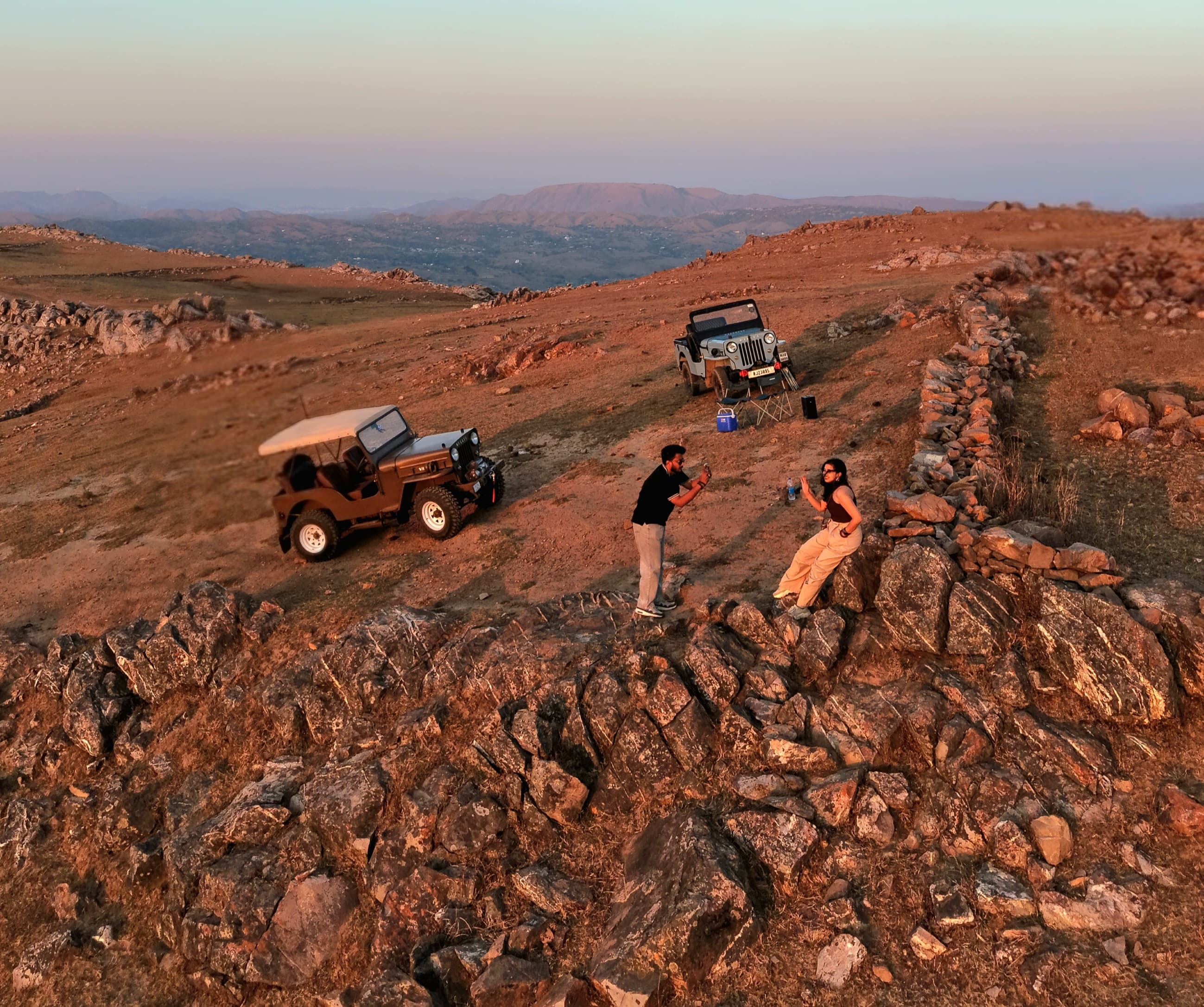
What there is instead: golden rock and scrub on slopes that change colour through the day, open valleys that appear as you crest a rise, dam viewpoints where water sits against stone, and small hamlets where ordinary rural life carries on with no interest in you being there. Birds are abundant. Goats are everywhere. On a clear winter morning you can see ridgelines stacked four or five deep.
The pleasure is cumulative rather than climactic. It builds over a few hours of moving through terrain rather than arriving at one thing, which is exactly why it does not photograph well in a brochure and why the people who like it tend to like it a lot.
There is also the quiet, which is difficult to convey until you have experienced the contrast. Udaipur's old city is loud. Twenty minutes into the hills, it is not.
Doing it as a Rajasthan jeep safari
Most of the interesting ground here is not reachable in a sedan. The tracks are unpaved, uneven and steep in sections, and a taxi will turn around well before the good parts.
A Rajasthan jeep safari solves that in two ways. The four wheel drive handles terrain a car cannot, and the open sides remove the barrier between you and the place. In an open vehicle you get the temperature dropping as you climb, the smell of dust and dry grass, and the ability to shoot in any direction without a window frame in the way. Anyone who has done both will tell you the closed-car version of these hills is a fraction of the experience.
The word safari confuses people, so worth clarifying: unlike a Rajasthan jeep safari in Ranthambore or Jawai, this is not a wildlife product. Nobody is promising you a leopard. The subject is landscape and terrain.
GoWilly runs a restored open-sided willly called Juniper on its routes, with a Trail Captain driving and guiding. Nobody in your group is navigating or picking lines through rough ground, which matters more on hill tracks than it does on city roads.
The two routes worth knowing
There are broadly two ways to do the Aravalis from Udaipur, and they are not interchangeable.
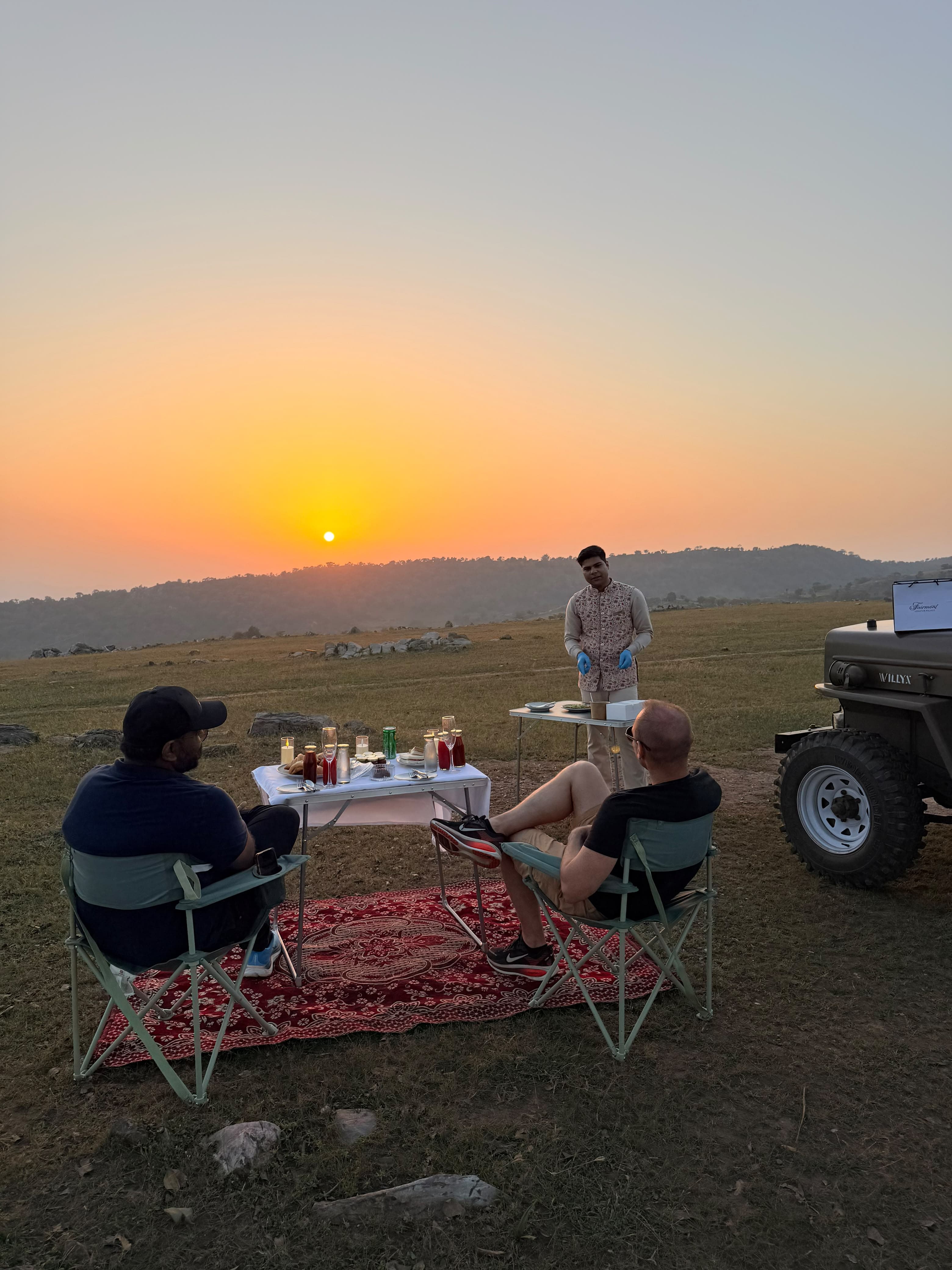
The gentler version folds a hill drive into a city day. Gowillly Udaipur Heritage Jeep Safari is a five to six hour half day that covers the City Palace, Saheliyon Ki Bari and the old-city lanes, then includes a scenic willly drive through the Aravali foothills before finishing at Sajjangarh with high tea and a panoramic sunset. It is graded easy. You get the hills as an ingredient rather than the main course, which is the right call if you are short on days.
The full version goes properly in. Gowillly Unexplored Aravali off-road trail is a six to seven hour day graded moderate and off-road. It leaves the city along Rani Road, spends two to two and a half hours on genuine off-road terrain through golden hills and open valleys, stops at dam viewpoints and remote spots chosen for the view rather than the signage, passes quiet hamlets, and closes at a camping zone in the hills with high tea as the sun drops.
If the hills are the reason you are booking anything, take the second one.
When to go
October to March is the comfortable season and it is the window GoWilly lists across its trails. Mild days, cool evenings, clear air, and an open vehicle is pleasant at almost any hour. Visibility in December and January is usually the best of the year, which matters when the whole appeal is long views.
September and early October are the visual peak. The hills hold their monsoon green for a few weeks and the light is clean after the rain clears. This is the most underrated time to do it.
Monsoon proper, July into September, is dramatic and wet. The range comes alive, but an open Jeep in heavy rain is exactly as wet as it sounds, so treat it as a trade rather than a straight win.
Summer is hot and the hills offer little shade. Tours run year-round with earlier departures in the hotter months, and a dawn start in May is genuinely fine. A midday one is not.
Within any season, the last two hours of daylight are when the ridgelines separate into layers and the rock goes warm. Book the afternoon slot if you can only pick one.
Who it suits, and what to expect physically
Off-road hill routes are bumpy. Not dangerous, but sustained, and a couple of hours of uneven ground is tiring in a way that a smooth road is not. If anyone in your group has back trouble or significant mobility limitations, the easier heritage route with its foothill drive is the better fit.
Otherwise it works well for a wide range of people. Couples, small groups of friends, photographers and repeat visitors all get a lot out of it. Older children usually enjoy the rough sections more than the adults do. Bookings run private to your travelling group of two to ten guests, so you are not sharing a vehicle with strangers or waiting on anyone else's schedule.
The people who tend not to enjoy it are those who want a defined list of sights to tick. This is a day about terrain and time, and if that framing does not appeal, a city itinerary will serve you better.
Photographers are the clearest case for booking it. The hills give you depth, layered ridgelines and side light that the flat lake views cannot, and an open vehicle means you shoot without asking anyone to pull over first.
Practical notes
Wear clothes you do not mind getting dusty. Off-road sections throw up a lot of it, and pale colours show every bit.
Bring sunglasses and sunscreen regardless of month. Wind and glare in an open vehicle are constant even in December.
Pack a light layer. The hills get noticeably cold at elevation once the sun goes, and the drive back down is breezy.
Keep your camera within reach rather than in a bag at your feet. Nothing here announces itself in advance.
Tell your Trail Captain what you care about before you set off. If you want light, or shorter stretches, or to stop wherever the birds are, saying so at the start changes the shape of the day.
Planning yours
Both hill routes run as private experiences quoted on your date and group size, with hotel pickup and drop inside Udaipur, and fuel, tolls, parking and permits included. There is no deposit and no paperwork on your side.
If you are undecided between the half-day heritage route with its foothill drive and the full off-road day, compare the stop lists and durations across Gowillly Udaipur trails before booking. They do different jobs, and the right one depends mostly on how many days you have and how much bouncing around you are up for.
FAQs
1. What is an Aravali hills tour in Udaipur?
It is a guided trip into the Aravali range that surrounds the city, usually run in an open four wheel drive. Routes cover hill tracks, valleys, dam viewpoints and rural hamlets rather than monuments. Options range from a scenic foothill drive folded into a city itinerary to a full day of genuine off-road terrain outside Udaipur.
2. How old are the Aravali hills?
The Aravali range dates to the Precambrian and formed during the Aravalli-Delhi orogeny, making it the oldest fold-mountain belt in India and far older than the Himalayas. What survives today is a heavily eroded remnant of a much higher range. It runs about 670 kilometres from near Delhi to Gujarat, with Guru Shikhar at Mount Abu its highest point at 1,722 metres.
3. Is an Aravali hills tour better than standard Udaipur sightseeing?
Neither is better, they answer different questions. City sightseeing gives you the palaces, gardens and lake views. A hills tour gives you terrain, quiet and long views with almost no crowds. If you have one day and have not seen the City Palace, do the city. With two or more days, or on a repeat visit, the hills are the stronger use of time.
4. Do I need a four wheel drive for the Aravali hills?
For the foothill roads and the drive up to Sajjangarh, no. For the off-road sections further out, yes. Tracks are unpaved, uneven and steep in places, and an ordinary car will turn back before the better scenery. A Rajasthan jeep safari style open Jeep handles the terrain and gives you unobstructed views at the same time.
5. What is the best month for an Aravali hills tour from Udaipur?
October to March is the most comfortable stretch, with mild days and clear winter visibility. September and early October are the most striking, since the hills stay green after the monsoon. Summer works with a dawn start, and monsoon is spectacular but carries a real chance of rain in an open vehicle. Late afternoon gives the best light in any season.